
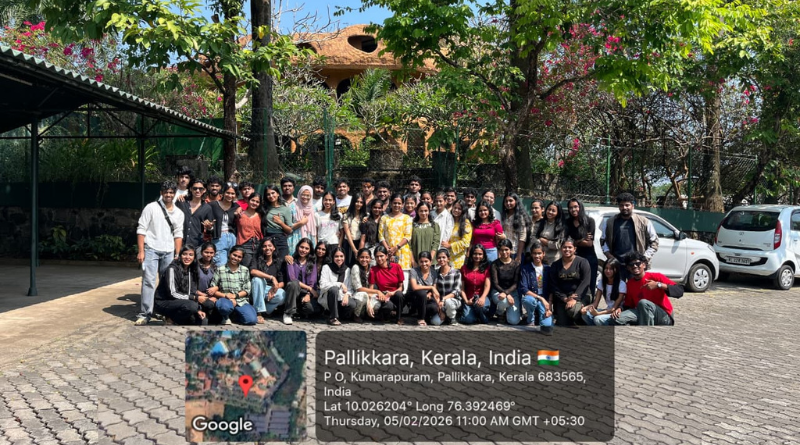
Industrial visit to a Virtual Reality facility by S4 CSE B students
A one-day industrial visit was organized for the students of Industrial Visit to a Virtual Reality Facility by S4 CSE B Students Batch to the Virtual Reality (VR) facility at Wonderla Holidays Limited, Kochi, on 05 February 2026. The primary objectives of this visit were to provide students with practical exposure to immersive technologies and to understand their real-world industrial applications, operational management, and safety protocols.
The visit was attended by a total of 49 participants (15 boys and 34 girls), accompanied by faculty members Ms. Soumya Sijo (Asst. Prof, CSE Dept) and Ms. Remya Krishna J S (Asst. Prof, CSE Dept)
The primary objectives of the visit were:
-
To provide students with practical exposure to Virtual Reality (VR) technology.
-
To understand real-world industrial applications, operational management and safety practices.
-
To bridge the gap between theoretical classroom learning and industry-standard implementations of immersive systems.
The core of the industrial visit focused on the underlying fundamentals of Virtual Reality (VR) technology and its transformative role within the modern entertainment industry. Technical experts at the facility provided an in-depth exploration of how immersive environments are synthesized using advanced hardware-software ecosystems. A significant portion of the demonstration centered on Hardware and Motion Tracking, where students observed the mechanical and electronic working principles of VR headsets. The staff detailed how integrated sensors and controllers work in tandem to capture and translate real-world physical movements into immediate digital responses within the virtual space.
Furthermore, the session emphasized the critical nature of System Performance and Rendering. It was explained that maintaining low latency and utilizing high-resolution displays are non-negotiable requirements for achieving true user immersion and preventing sensory mismatch. The technical presentation specifically highlighted the indispensable role of Graphics Processing Units (GPUs) in performing real-time 3D rendering and the necessity of precise equipment calibration to ensure spatial accuracy. To round out the sensory experience, the integration of spatial audio systems was demonstrated, showing how directional sound significantly enhances the realism of the simulation.
Beyond the technical architecture, students gained insights into the Operations and Safety protocols required to manage a large-scale VR facility. The operational workflow includes rigorous maintenance schedules, troubleshooting protocols, and system reliability checks to ensure uptime. From a user-experience perspective, the staff outlined strict safety guidelines regarding usage duration to mitigate motion sickness and established hygiene standards for shared peripherals. Additionally, the visit covered the continuous monitoring of user data and safety parameters, ensuring a secure environment for all participants.
Industrial Applications and Career Insights
The visit concluded with an expansive discussion on the scalability and future of VR systems. While the facility at Wonderla primarily showcases entertainment applications, the staff introduced students to the burgeoning “Industrial VR” footprint. This includes Education and Training, where immersive simulations allow for the safe practice of complex or hazardous tasks. The session also touched upon evolving models of Human-Computer Interaction (HCI) and how VR is redefining the way humans interface with digital data. Students were encouraged to view VR as a multidisciplinary field—a convergence of Computer Science, Electronics, and Design—offering diverse innovation and career opportunities.
5. Program Outcomes (POs) Attained
The industrial visit served as a practical bridge to the curriculum, successfully contributing to several key engineering Program Outcomes.
-
PO1 — Engineering Knowledge, students were able to effectively correlate theoretical concepts of computer graphics, hardware-software integration, and immersive systems with real-world Virtual Reality applications
-
PO5 — Modern Tool Usage by providing direct exposure to advanced VR equipment, motion tracking systems, and real-time rendering technologies, thereby enhancing student awareness of contemporary engineering tools used in the industry.
-
PO9 — Individual and Team Work, as students developed collaborative learning skills by observing coordinated operational practices and participating collectively in the industrial environment.
-
Finally, in alignment with PO12 — Life-long Learning, exposure to emerging technologies such as Virtual Reality motivated students to explore advanced technological domains and pursue continuous professional development.