
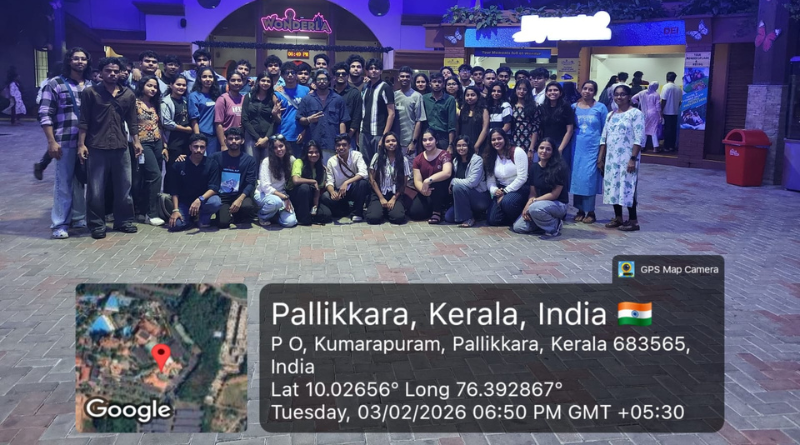
S4 CSE A batch students explore Virtual Reality Technology
To provide students with practical exposure to Virtual Reality (VR) technology and its real-world industrial applications, the industrial visit was conducted for S4 CSE A batch Students during the Academic Year 2025–2026 under the title “Industrial Visit to a Virtual Reality Facility at Wonderla Holidays Limited, Kochi” on 03 February 2026
The objective of the visit was to familiarize students with Virtual Reality (VR) technology through practical exposure and to help them understand its real-world industrial applications, operational workflows and safety measures. The visit was led by Dr. Jensy Babu(Asst Prof, CSE Dept) and Ms. Nikhitha C. Balan (Asst Prof, CSE Dept) . A total of 46 students participated in the visit, including 27 boys and 19 girls.
A one-day industrial visit was organized for the students of S4 CSE B, Department of Computer Science and Engineering, to the Virtual Reality facility at Wonderla Holidays Limited, Kochi on 03 February 2026. The group departed from the college campus at 7:00 AM and reached the destination as scheduled.
During the visit, students were introduced to the fundamentals of Virtual Reality (VR) technology and its role in the modern entertainment industry. The session began with a brief explanation of how immersive environments are created using advanced hardware and software systems. The technical staff explained the working principles behind VR headsets and motion-tracking systems. Students observed how visual displays are rendered in real time to ensure a seamless user experience.
The integration of sensors and controllers was demonstrated in detail. The functioning of motion detection devices was explained with practical examples. Students were able to understand how real-world movements are translated into digital responses. The importance of low latency in VR systems was highlighted during the demonstration, and the role of high-resolution displays in enhancing immersion was also discussed.
The staff emphasized the need for proper calibration of equipment before operation. Students learned about the internal components of VR devices and the significance of graphics processing units in rendering 3D environments. The concept of immersive simulation was demonstrated through interactive sessions.
Safety protocols followed while operating VR systems were clearly outlined. Guidelines regarding the duration of usage were explained to prevent discomfort. The importance of maintaining hygiene standards for shared equipment was also discussed. Students observed how technical supervision is maintained during each session.
The operational workflow followed before allowing participants into the VR setup was demonstrated. The maintenance procedures carried out to ensure system reliability were described, and staff members explained how troubleshooting is handled in case of technical issues.
The integration of audio systems for enhancing realism was demonstrated. Students gained insight into how synchronization between sound and visuals improves the overall experience. The role of programming in developing interactive VR content was briefly introduced, and the importance of software updates for system efficiency was highlighted.
Students observed how real-time feedback mechanisms function in virtual environments. The industrial applications of VR beyond entertainment were also discussed, including examples from education and training sectors. The session highlighted how VR is transforming user interaction models and creating emerging career opportunities in the field.
The scalability of VR systems for commercial use was explained, along with energy management considerations for running such facilities. The staff explained how user data and safety parameters are monitored continuously. Students also observed the coordination required between technical and operational teams.
The structured scheduling system followed in managing visitors was observed. The economic aspects of operating a VR attraction were briefly discussed, and the importance of quality assurance in ensuring customer satisfaction was highlighted.
Students were encouraged to think about future technological advancements in VR. The practical demonstration helped reinforce theoretical concepts learned in class. The interactive nature of the session increased student engagement and enabled students to connect classroom learning with real-time industrial applications.
The experience enhanced their understanding of human-computer interaction. The session also demonstrated the importance of teamwork in managing technical systems. Students realized the multidisciplinary nature of VR technology through the combination of computer science, electronics, and design principles.
The visit provided clarity on the practical challenges faced in implementing immersive technologies and helped students appreciate the complexity of managing large-scale interactive systems. Overall, the visit provided comprehensive insight into the operational and technical aspects of Virtual Reality systems used in the entertainment industry.
PROGRAM OUTCOMES
The industrial visit to the Virtual Reality facility at Wonderla Holidays Limited contributed to the attainment of the following outcomes:
PO1 – Engineering Knowledge:
Students were able to correlate theoretical concepts of computer graphics, hardware-software integration, and immersive systems with real-world Virtual Reality applications.
PO5 – Modern Tool Usage:
The visit provided exposure to advanced VR equipment, motion-tracking systems, and real-time rendering technologies, enhancing awareness of contemporary engineering tools.
PO9 – Individual and Team Work:
Students developed collaborative learning skills by observing coordinated operational practices and participating collectively in the industrial visit.
PO12 – Life-long Learning:
Exposure to emerging technologies such as Virtual Reality motivated students to explore advanced technological domains and pursue continuous professional development.