
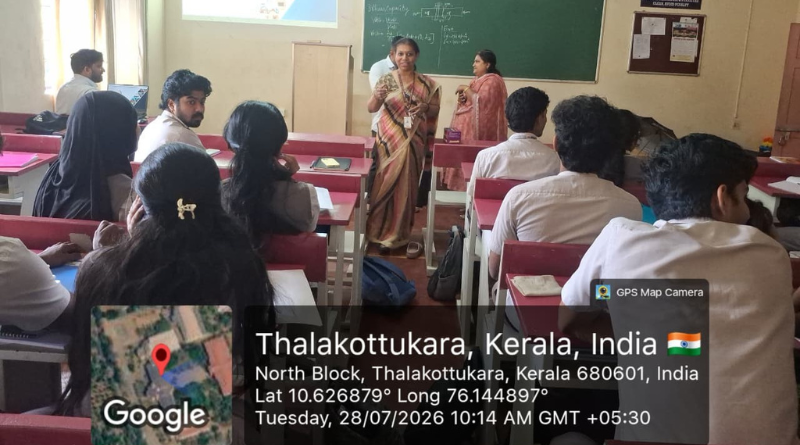
One-Day Workshop on Practical aspects of Civil Engineering (CE) by PIE Builders and Developers in association with the School of PIE
The Department of Civil Engineering provides students with practical knowledge, technical skills and industry exposure in the fields of civil engineering and construction.
A one-day workshop was conducted by PIE Builders and Developers in association with the School of PIE for Final year B Tech CE students on 28 July 2026. The workshop focused on bridging the gap between classroom learning and real-world construction practices. Experienced professionals shared their expertise through demonstrations, interactive sessions and practical activities, enabling participants to understand the latest trends, technologies and career opportunities in the construction industry.
Workshop Sessions
The workshop began with a practical session on measuring room dimensions using a measuring tape. Students learned the correct techniques for measuring the length, width, and height of rooms, which are essential for preparing accurate building plans and estimating construction materials.
The next session focused on unit conversion, where participants learned how to convert different units used in civil engineering, such as millimetres, centimetres, metres, square metres, cubic metres, and feet. The importance of accurate unit conversion in planning, estimation, and execution of construction projects was emphasized.
A demonstration on water levelling introduced students to the principles of level measurement using a water level tube. The trainers explained its application in checking horizontal levels during construction and highlighted its importance in ensuring structural accuracy.
The participants were also taught direction identification using basic compass directions and their significance in site planning and building orientation. The session explained how proper orientation improves ventilation, natural lighting, and overall building efficiency.
Construction Process and Materials
One of the key sessions explained the construction process and various stages of building construction, starting from site selection, soil testing, foundation work, superstructure construction, roofing, plastering, flooring, electrical and plumbing works, and finally finishing and handover. The trainers described each stage in detail and discussed the importance of quality control throughout the construction process.
The workshop also covered construction materials commonly used in modern buildings, including cement, steel, bricks, concrete, sand, aggregates, tiles, paints, and wood. Participants were introduced to the approximate current market prices of these materials and learned how fluctuations in material costs affect project budgeting and estimation.
Another important session focused on the importance of entrepreneurship in civil engineering. The speakers motivated students to develop leadership qualities and encouraged them to consider starting their own construction firms, consultancy services, or contracting businesses instead of depending solely on employment opportunities.
Career Opportunities and Digital Technologies
The resource persons explained the wide range of career opportunities in civil engineering, including roles such as site engineer, structural engineer, quantity surveyor, project manager, quality control engineer, planning engineer, estimator, and government engineer. They also highlighted opportunities in higher education, research, entrepreneurship, and overseas employment.
A special session introduced K-SMART (Kerala Solutions for Managing Administrative Reformation and Transformation), explaining its role in providing digital governance services. Students learned how K-SMART simplifies online applications related to building permits, local self-government services, and approvals.
The workshop also included training on plan drawing and the basic principles of preparing building plans according to construction standards. Participants gained an understanding of floor plans, elevations, sections, and site plans. The speakers further explained the building permit process, including the documents required, approval procedures, and the importance of complying with local building regulations.
Another informative session focused on interior and exterior planning, where participants learned the fundamentals of space utilization, aesthetic design, landscaping, ventilation, lighting, and façade planning to enhance the functionality and appearance of buildings.
Finally, the trainers introduced several civil engineering software applications widely used in the industry, such as AutoCAD, Revit, STAAD.Pro, ETABS, SketchUp, and MS Project. They explained how this software tools assist engineers in drafting, structural analysis, 3D modelling, project planning, and construction management.
The workshop was coordinated by Dr Abhilasha P.S (HoD, CE Dept) and Dr Anjali P Sasidharan (Asso. Prof, CE Dept). Overall, the workshop was an enriching learning experience that motivated students to pursue excellence in the field of civil engineering and construction.
| The Editorial Team of News & Events joins the entire Vidya fraternity in congratulating Dr. Abhilasha and Dr. Anjali on conducting an insightful session that enhances participant’s technical knowledge, practical skills and awareness of career opportunities and entrepreneurship !!! |