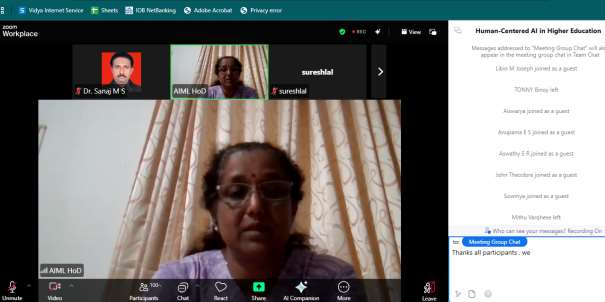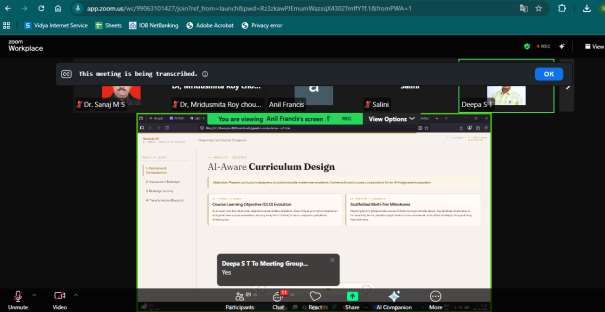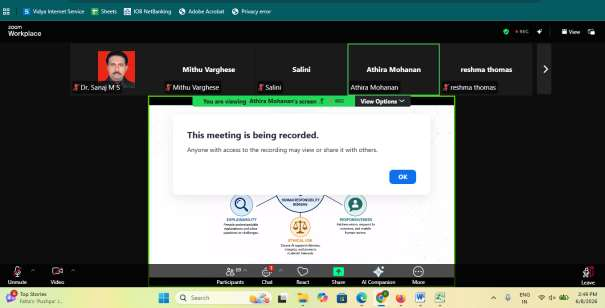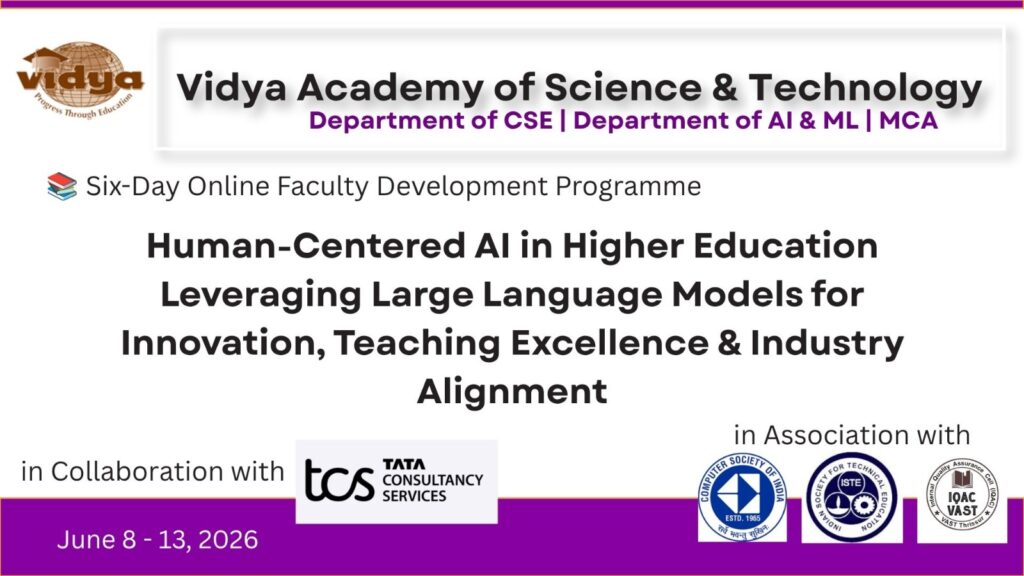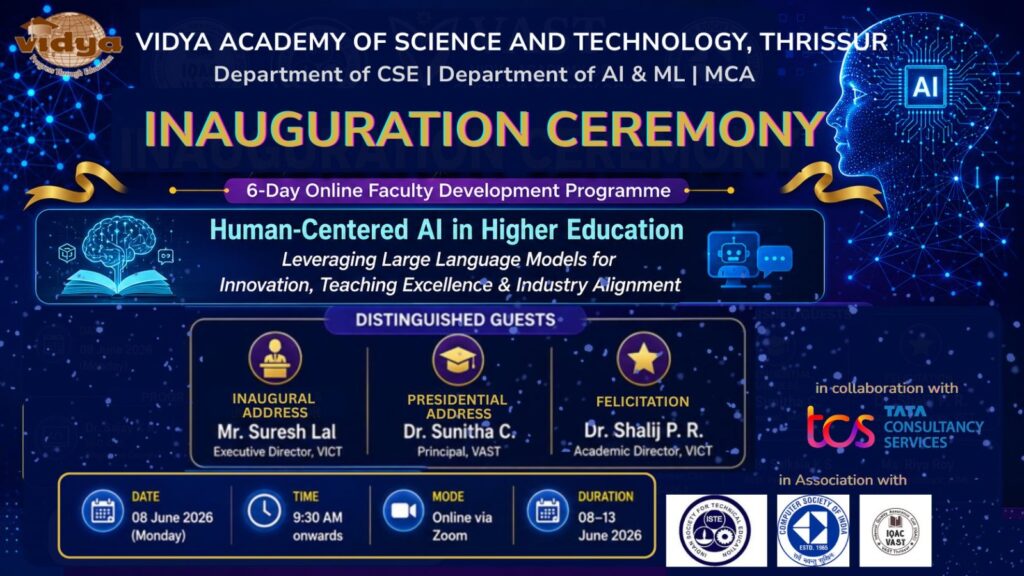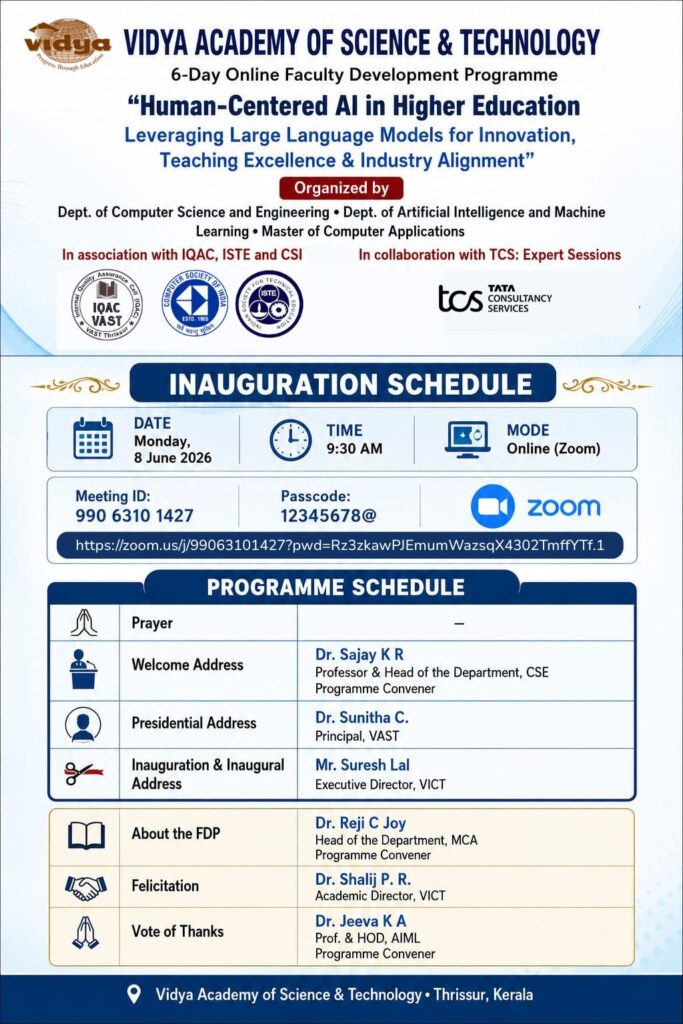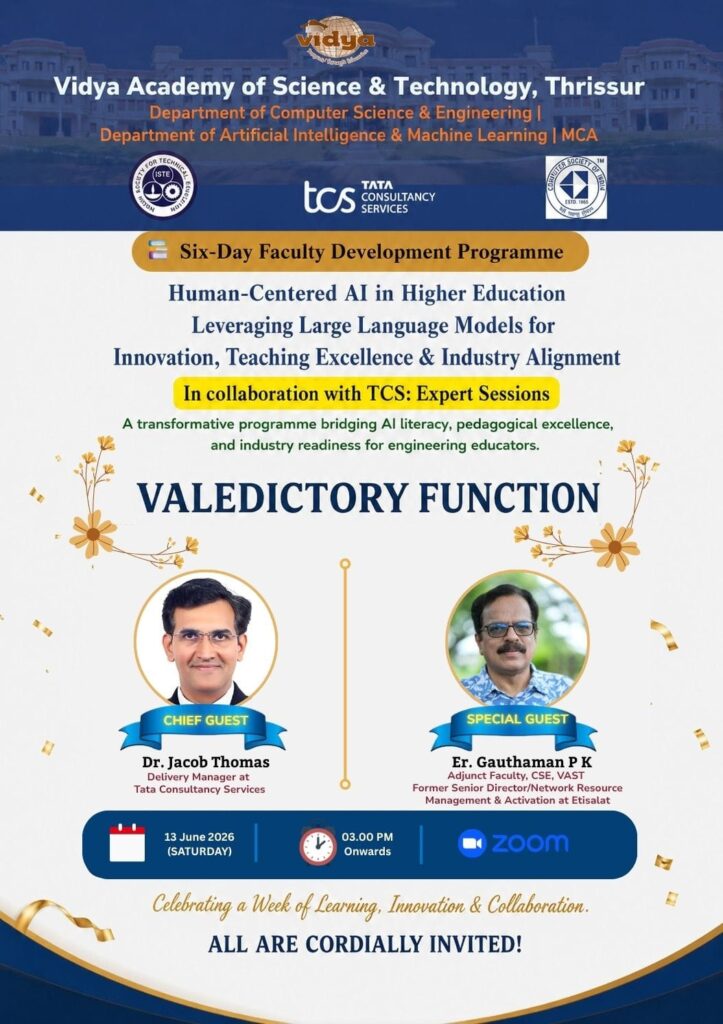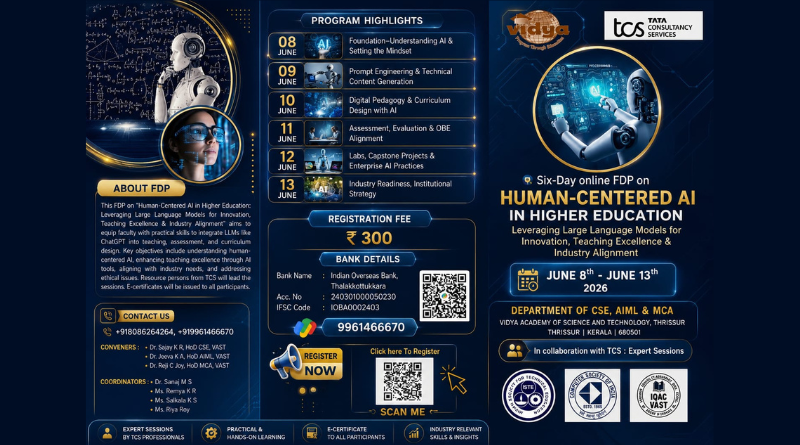
Vidya conducts FDP on “Human-Centered AI in Higher Education: Leveraging Large Language Models for Innovation, Teaching Excellence & Industry Alignment”
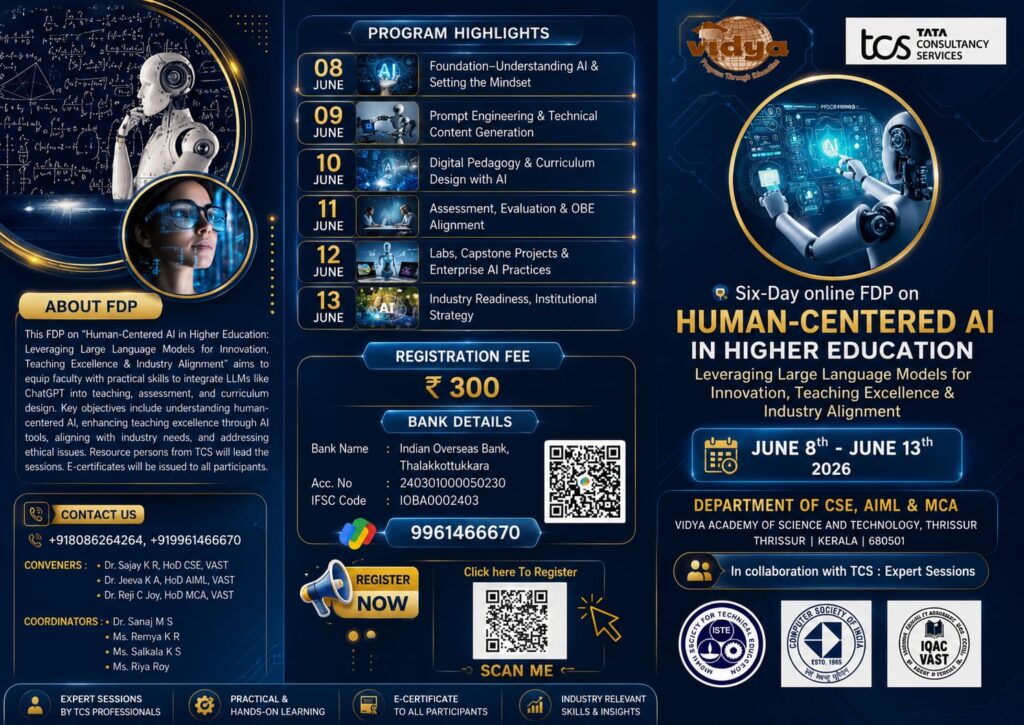
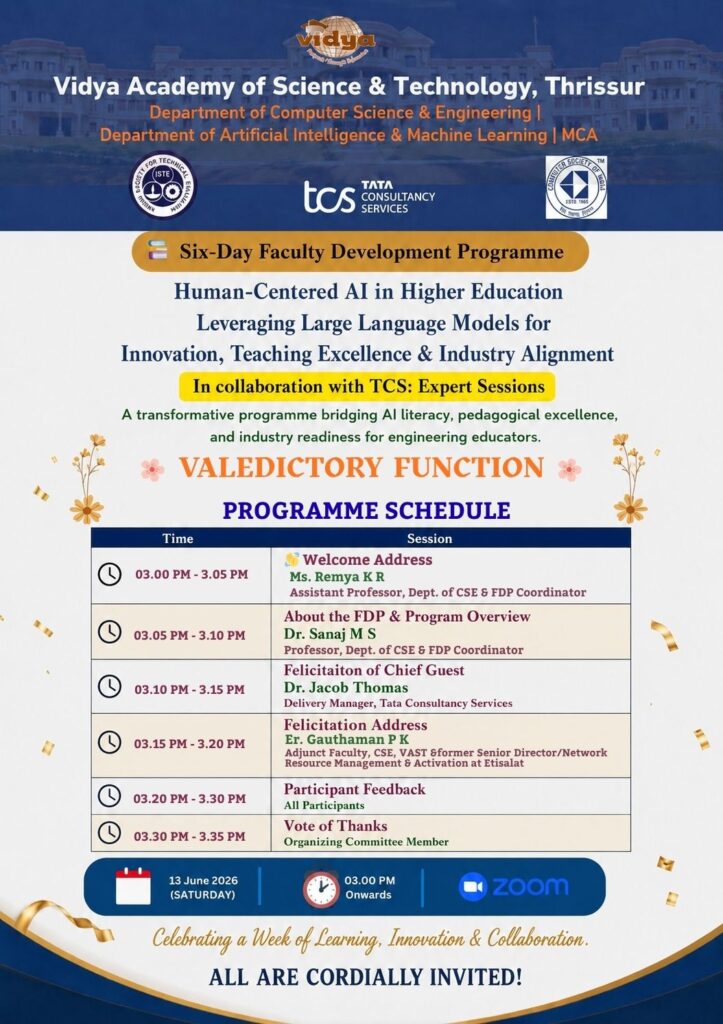
To close the critical skill gap emerging between traditional engineering pedagogy and the fast-accelerating world of corporate artificial intelligence development, the Department of Computer Science & Engineering, the Department of Artificial Intelligence & Machine Learning, and the Department of Master of Computer Applications jointly organized a six-day intensive Online Faculty Development Programme (FDP) Human-Centered AI in Higher Education: Leveraging Large Language Models for Innovation, Teaching Excellence & Industry Alignment from 08 June 2026 – 13 June 2026, catering specifically to engineering faculty and academic heads. To further attract forward-thinking academic leaders, the programme showcased a unique blend of industry-aligned modules, hands-on architectural sandboxing, and strategic deployment blueprints designed to seamlessly revolutionize modern engineering classrooms
Over the course of twelve highly targeted sessions, participants transitioned through baseline AI literacy, advanced prompt architecture frameworks (such as CRAFT), local Large Language Model runtime management via Ollama, Retrieval-Augmented Generation (RAG) pipelines, Outcome-Based Education (OBE) alignment strategies, and concrete corporate automation use cases.
DAILY SESSION PROCEEDINGS
DAY 1: Tuesday, 08 June 2026
-
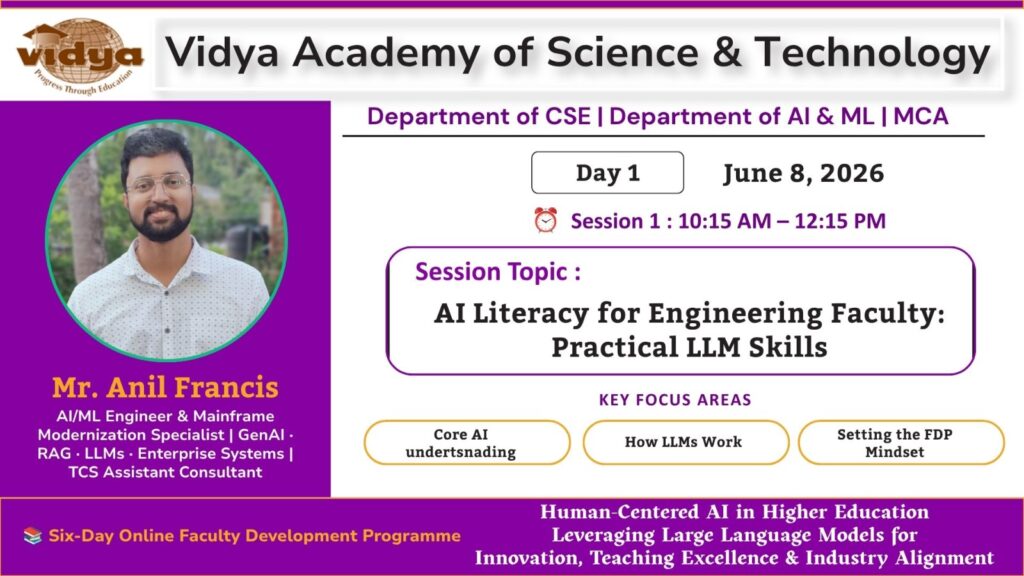
Session 1: AI Literacy for Engineering Faculty: Practical LLM Skills
-
Time: 10:15 AM to 12:15 PM
-
Resource Person: Mr. Anil Francis, AI/ML Engineer, Mainframe Modernization Specialist, and Assistant Consultant at Tata Consultancy Services (TCS).
-
Summary: The inaugural session established foundational AI literacy metrics tailored to modern engineering mentors. The resource person mapped out structural distinctions across artificial intelligence subdivisions, detailing the inner mechanics of Large Language Models (LLMs) and outlining the crucial need for establishing an AI-ready mindset. Practical demonstrations guided faculty through running secure, decentralized models locally using the Ollama environment. A deep technical breakdown of Retrieval-Augmented Generation (RAG) models was presented, showcasing how RAG reduces AI hallucinations and preserves internal verification loops by dynamically referencing trusted, external institution data repositories rather than relying entirely on parameterized weights. The lecture also demonstrated efficient automation pathways spanning automated literature reviews, course syllabus planning, assessment blueprinting, presentation construction, and institutional report formulation.
-
-
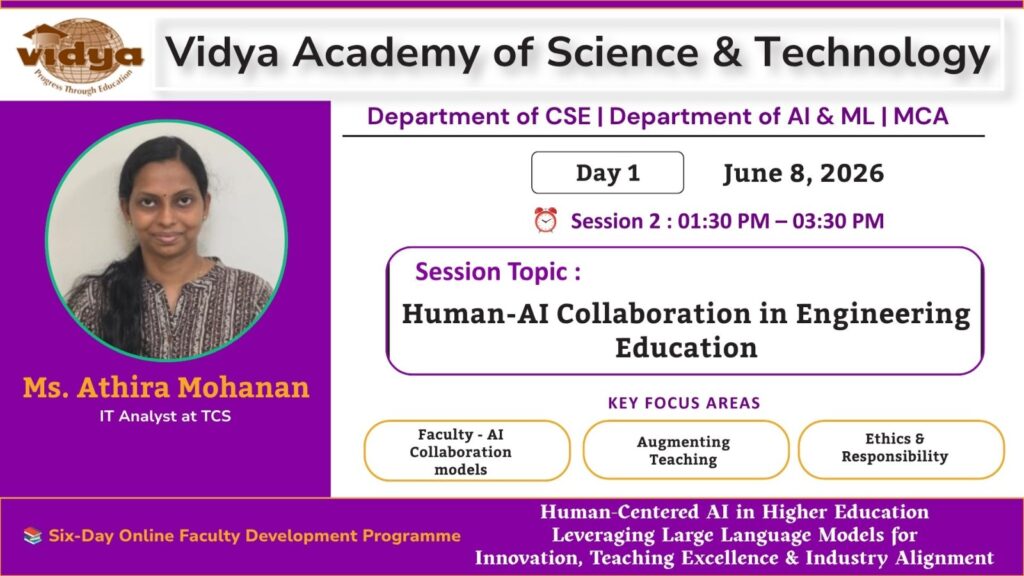
Session 2: Human-AI Collaboration in Engineering Education
-
Time: 01:30 PM to 03:30 PM
-
Resource Person: Ms. Athira Mohanan, IT Analyst at Tata Consultancy Services (TCS).
-
Summary: This session focused on human-in-the-loop workflows within modern higher education. The speaker strongly argued against treating generative systems as replacements for senior human faculty, instead demonstrating how to build robust collaborative partnerships. The technical models presented showed how automated workflows can handle heavy repetitive tasks, such as baseline course grading, specialized item-bank compilation, and adaptive student track profiling. Concurrently, the discussion highlighted complex data protection challenges, student privacy boundaries, the mitigation of inherent model biases, and structural transparency metrics. Real-world corporate case studies were introduced, providing faculty with a clear understanding of the AI-driven engineering teams their students will join post-graduation.
-
DAY 2: Wednesday, 09 June 2026
-
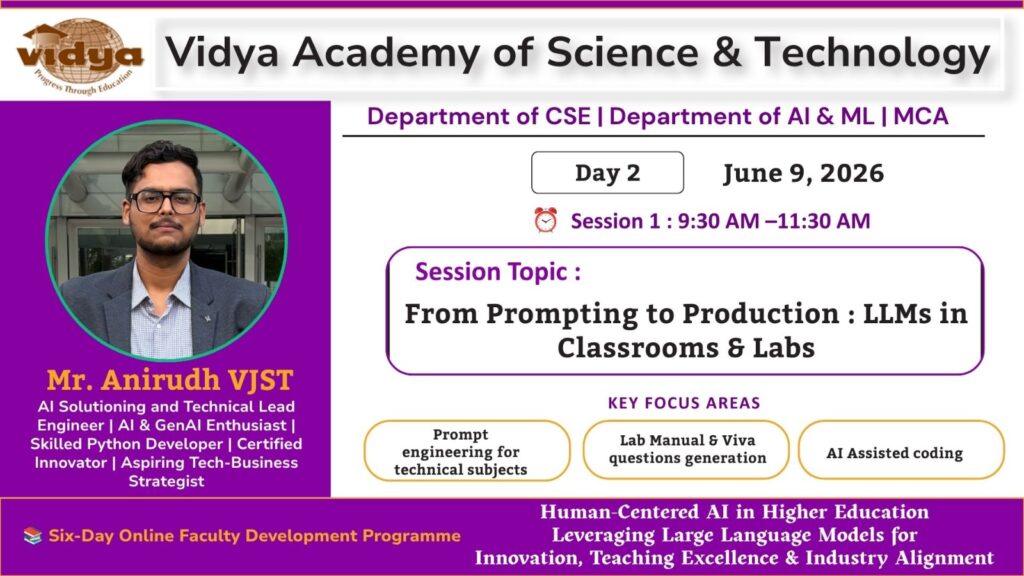
Session 1: From Prompting to Production: LLMs in Classrooms & Labs
-
Time: 09:30 AM to 11:30 AM
-
Resource Person: Mr. Anirudh VJST, AI Solutioning and Technical Lead Engineer, Skilled Python Developer, and Certified Innovator.
-
Summary: This session shifted focus from conversational interaction to prompt engineering. Prompt design was framed as an essential engineering skill needed to extract highly contextual, precise, and deterministic behaviors from complex stochastic models. The speaker introduced structured prompt construction rules, using the CRAFT framework to show how providing background context significantly improves the accuracy of AI outputs. Practical workspace exercises demonstrated how to automatically generate highly specialized laboratory execution manuals, detailed viva question banks, and localized student handouts. The final segment focused on AI-assisted programming pipelines, demonstrating how coding assistants accelerate syntax debugging, log parsing, documentation writing, and code optimization in lab environments.
-
-
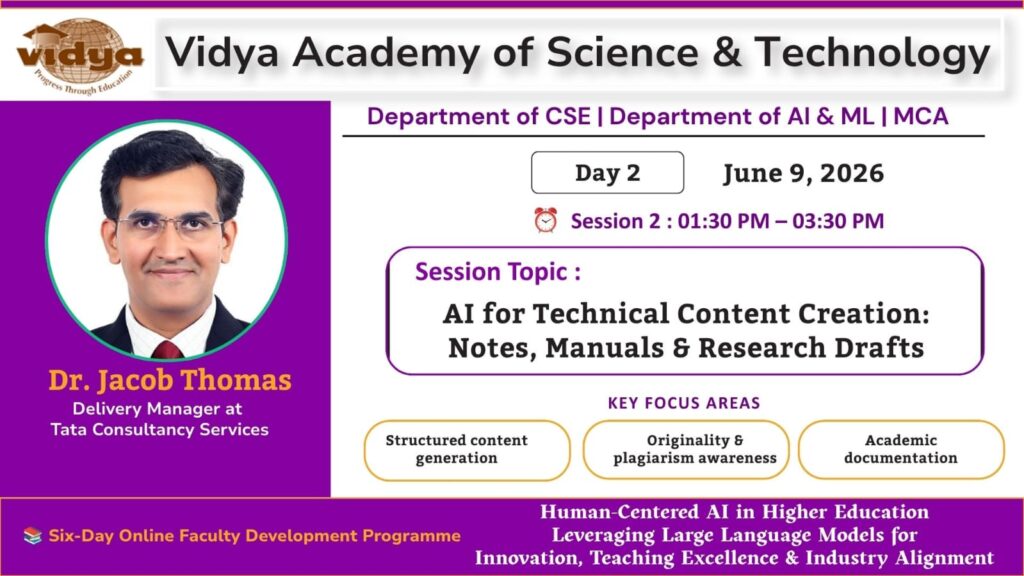
Session 2: AI for Technical Content Creation: Notes, Manuals & Research Drafts
-
Time: 01:30 PM to 03:30 PM
-
Resource Person: Dr. Jacob Thomas, Delivery Manager at Tata Consultancy Services (TCS).
-
Summary: This session provided a practical analysis of automated technical writing and institutional content development. The speaker detailed efficient methods for creating structured lecture notes, laboratory blueprints, and comprehensive study guides. The research-focused portion of the presentation covered automated drafting strategies for initial literature matrix synthesis, grant proposal outlines, indexing abstracts, and document layout formatting. Crucially, Dr. Jacob emphasized the requirement for strict verification and quality assurance. He reminded participants that faculty must manually review, edit, and validate all AI-generated text before classroom use or academic publication to ensure accuracy and maintain original scholarly integrity.
-
DAY 3: Thursday, 10 June 2026
-
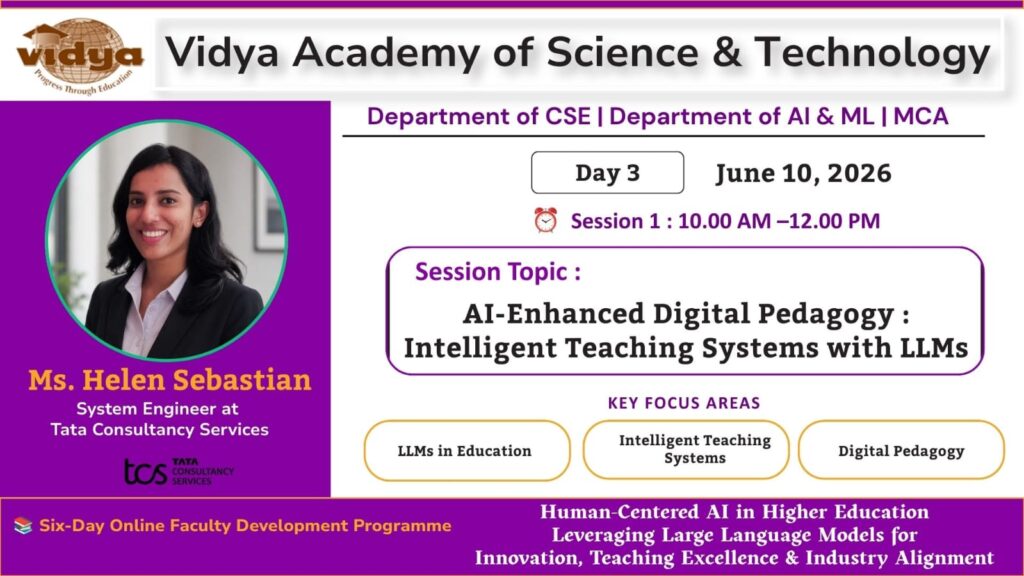
Session 1: AI-Enhanced Digital Pedagogy: Intelligent Teaching Systems with LLMs
-
Time: 09:30 AM to 11:30 AM
-
Resource Person: Ms. Helen Sebastian, System Engineer at Tata Consultancy Services (TCS).
-
Summary: This lecture explored the architectural intersection of advanced digital pedagogy and conversational intelligence engines. The speaker explained the technical underpinnings of Large Language Models, describing how Transformer-based attention mechanisms resolve word ambiguities by evaluating surrounding token matrices. The discussion detailed the structure of Intelligent Teaching Systems (ITS), highlighting real-time automated assessment models, personalized student feedback tracking, and multi-parameter learning analytics. The session concluded with practical integration guidelines, helping institutions roll out digital tutoring solutions while maintaining academic integrity and strict data security protocols.
-
-
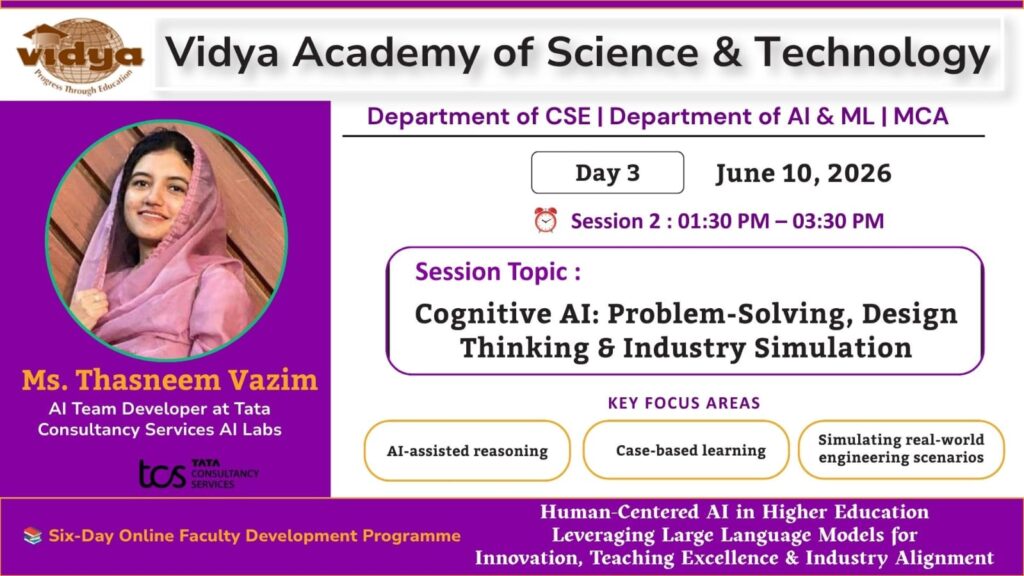
Session 2: Cognitive AI: Problem-Solving, Design Thinking & Industry Simulation
-
Time: 01:30 PM to 03:30 PM
-
Resource Person: Ms. Thasneem Vazim, AI Team Developer at TCS AI Labs.
-
Summary: This session introduced Cognitive AI architectures designed to mimic human learning, deep reasoning, and adaptive choice mechanics. The speaker outlined the data ingestion loops that allow cognitive models to identify meaningful trends and hidden data connections. A major focus area was Case-Based Reasoning (CBR) pipelines, which enable systems to reference stored contextual scenarios and provide actionable insights for new problems. The speaker also covered user-centered design thinking, showing how faculty can use industry simulations to model, project, and optimize outcomes across complex engineering challenges.
-
DAY 4: Friday, 11 June 2026
-
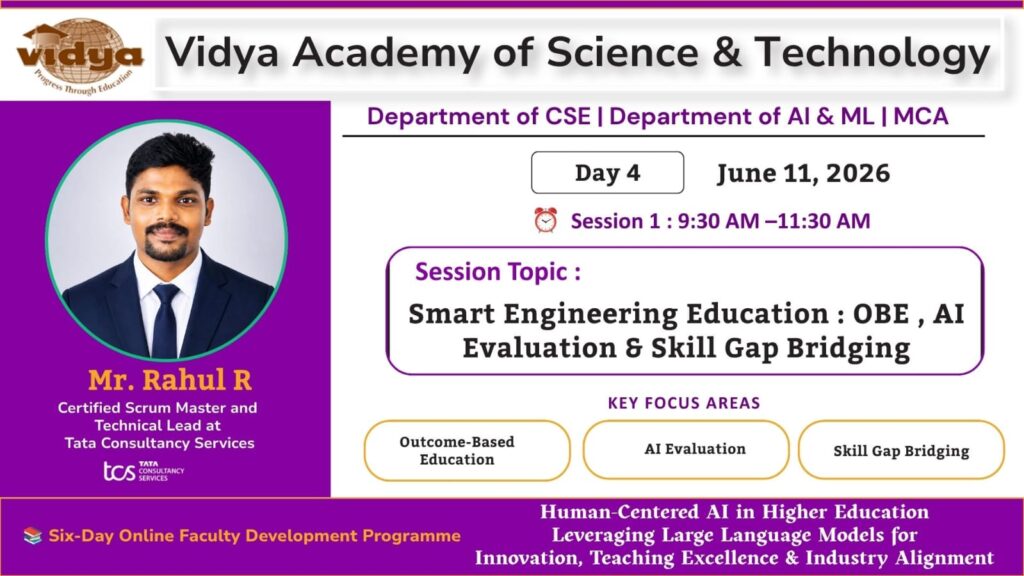
Session 1: Smart Engineering Education: OBE, AI Evaluation & Skill Gap Bridging
-
Time: 09:30 AM to 11:30 AM
-
Resource Person: Mr. Rahul R, Technical Lead at TCS, Certified Scrum Master, and Head of the AI & Analytics Centre of Excellence.
-
Summary: This session addressed the integration of Outcome-Based Education (OBE) principles with automated evaluation systems. The speaker outlined a structured approach to setting clear learning goals, tracking student progression metrics, and driving continuous quality improvements. The technical discussion covered adaptive quiz systems, automated rubric scoring for complex assignments, and real-time skill-gap analytics. Faculty completed practical exercises using modern models (such as Gemini) to run interactive student mentoring sessions, conduct mock interviews, and perform targeted competency reviews.
-
-
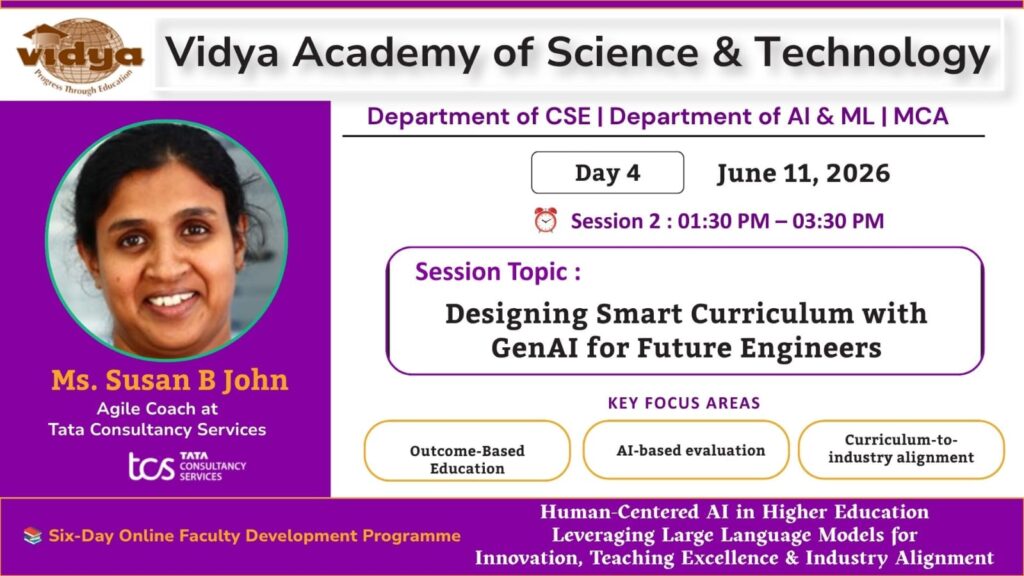
Session 2: Designing Smart Curriculum with GenAI for Future Engineers
-
Time: 01:30 PM to 03:30 PM
-
Resource Person: Ms. Susan B. John, Agile Coach at Tata Consultancy Services (TCS).
-
Summary: This session explored modern techniques for curriculum enhancement using generative model frameworks. The speaker outlined essential technology modules that should be integrated into modern engineering programs, including AI/ML fundamentals, Natural Language Processing, Deep Neural Networks, Cloud Infrastructure, Cyber Security, Cryptography, and Secure Coding standards. The presentation detailed how generative tools can automate initial syllabus drafting, structure relevant modular milestones, and map interdisciplinary learning pathways. A continuous improvement model was also presented, showing how to update curriculum contents by dynamically analyzing industry trend data and multi-stakeholder feedback.
-
DAY 5: Saturday, 12 June 2026
-
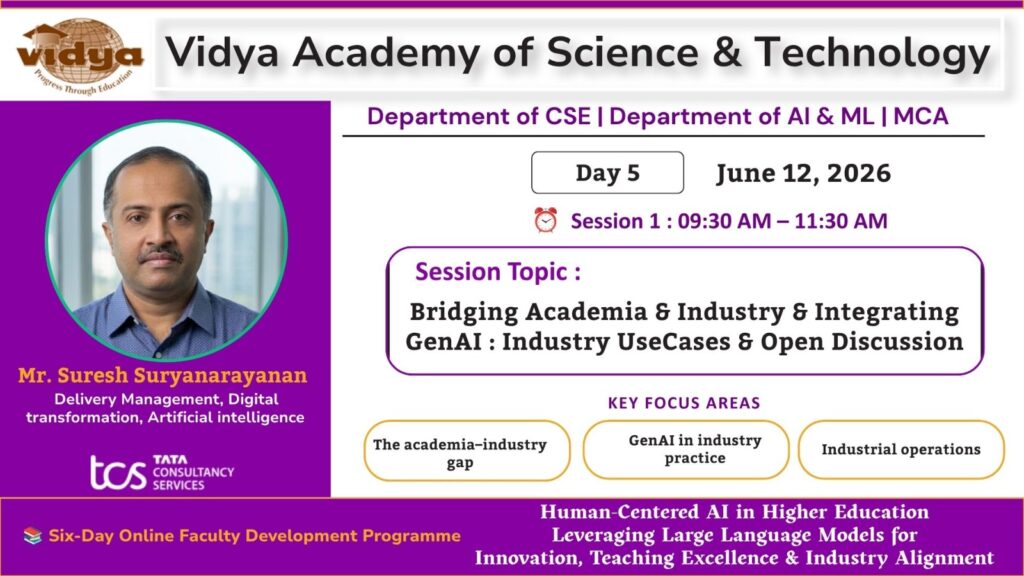
Session 1: Bridging Academia & Industry & Integrating GenAI: Industry Use Cases
-
Time: 09:30 AM to 11:30 AM
-
Resource Person: Mr. Suresh Suryanarayanan, Expert in Delivery Management, Digital Transformation, and Artificial Intelligence.
-
Summary: This session evaluated corporate production deployments of generative models and the real-world skills expected of modern engineering graduates. The speaker provided clear definitions of key industry concepts, distinguishing between single-turn Prompt Engineering, targeted task-specific AI Agents, and complex multi-process Agentic AI architectures. He also discussed practical safety mechanisms, including Guardrails and RAG infrastructure. To provide concrete context, the resource person detailed several operational use cases across enterprise domains: automated corporate meeting minute drafting using NLP sentiment tracking, mobile spam classification systems, automated fraud and anti-money laundering detection inside financial institutions, and recommendation models for corporate social responsibility (CSR) portfolio management.
-
-
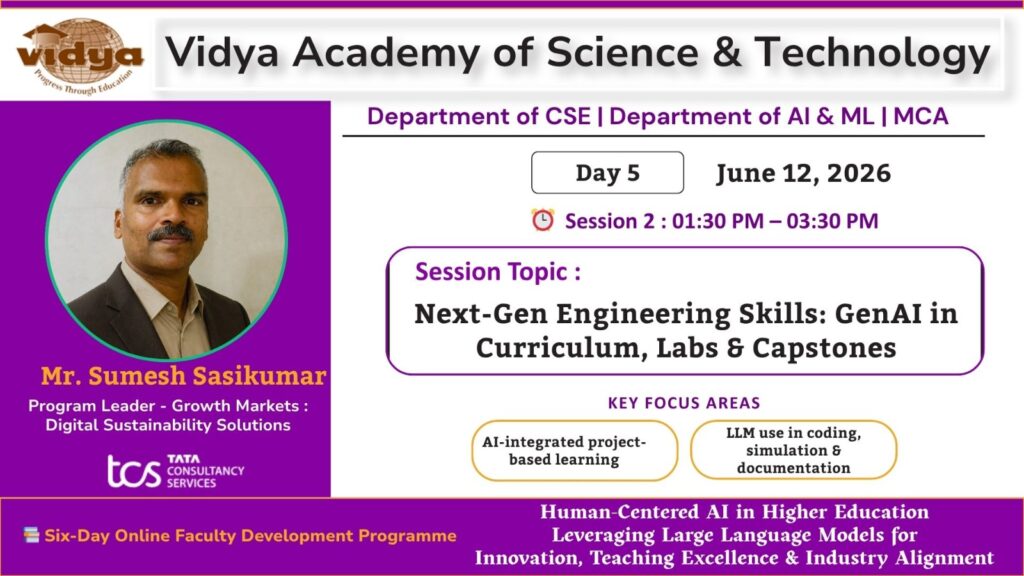
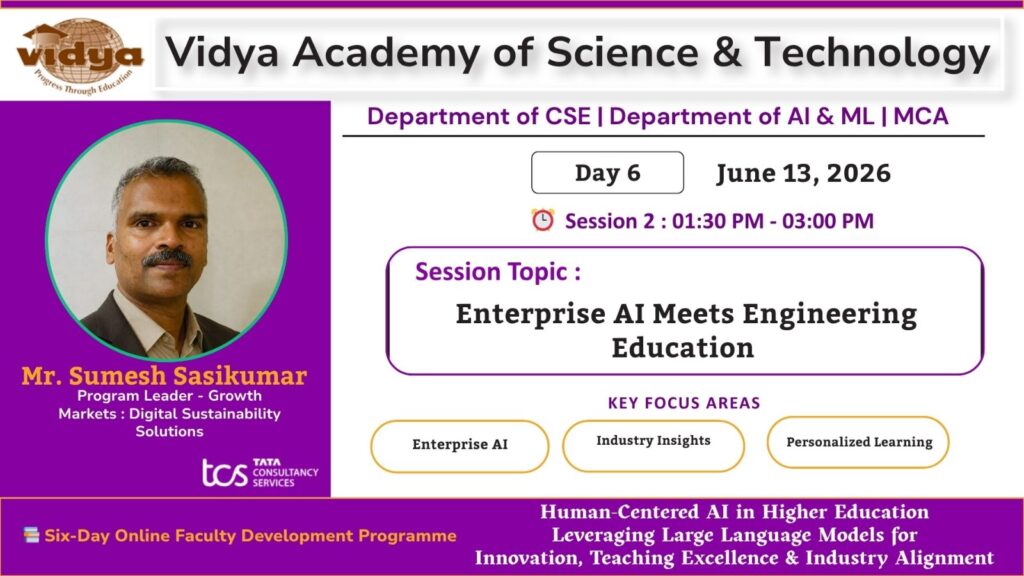
Session 2: Next-Gen Engineering Skills: GenAI in Curriculum, Labs & Capstones
-
Time: 01:30 PM to 03:30 PM
-
Resource Person: Mr. Sumesh Sasikumar, Program Leader – Growth Markets: Digital Sustainability Solutions, TCS.
-
Summary: The final detailed presentation focused on embedding AI systems into advanced laboratory experiments and senior capstone projects. The speaker introduced an AI-augmented Project Based Learning (PBL) model, detailing a strict 6-step problem-solving workflow: Problem Definition, Solution Criteria Mapping, Literature/Solution Research, Selection Matrix Execution, Prototype creation/testing, and Final reflective assessment. These steps were connected to established learning theories, mapping student progression via Bloom’s Taxonomy from basic memorization to higher-order cognitive creation. The speaker also discussed cognitive memory mechanics, explaining how information transfers from short-term sensory inputs to long-term memory via encoding. This framework was used to show how to design lab environments that shift students away from simple syntax copying toward deep architectural problem-solving.
-
DAY 6: Sunday, 13 June 2026
-
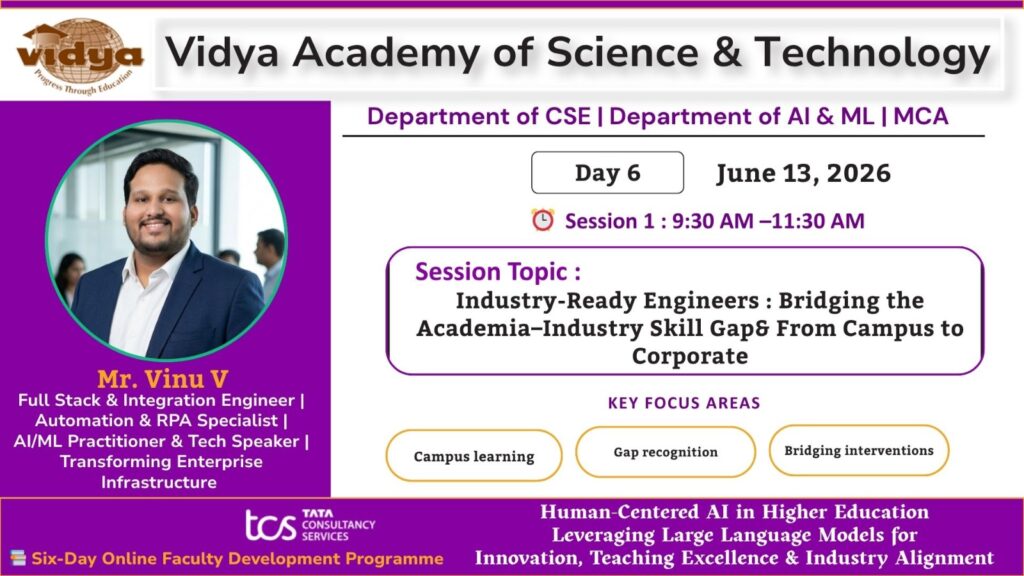
Session 1: Final Programme Review & Institutional Integration Roadmaps
-
Time: 09:30 AM to 11:30 AM
-
Resource Person: Mr. Vinu V, Full Stack & Integration Engineer, Automation & RPA Specialist, AI/ML Practitioner & Tech Speaker, Expert in Transforming Enterprise Infrastructure, Tata Consultancy Services (TCS).
-
Summary: The morning session of the final day focused on institutional integration roadmaps. Faculty members from various engineering departments assembled into focus groups to review the core operational frameworks covered during the week. Departmental leads collaborated to draft concrete structural integration proposals, establishing exact metrics for introducing local LLM runtimes (via Ollama) into technical computing labs and embedding contextual prompt design methodologies into engineering curriculum tracks. The session mapped out execution stages to transition classrooms from standard text delivery toward AI-assisted adaptive tutor model structures while maintaining human oversight boundaries.
-
-
Session 2: Collaborative Open Panel, Ethical Synthesis & Programme Evaluation
-
Time: 01:30 PM to 03:30 PM
-
Resource Person: Mr. Sumesh Sasikumar, Program Leader – Growth Markets: Digital Sustainability Solutions, Tata Consultancy Services (TCS).
-
Summary: The afternoon session served as a collaborative panel discussion and official evaluation space. The panel brought together academic administrators and senior engineering mentors to address critical challenges associated with institutional AI rollouts, including algorithmic bias mitigation, student data protection policies, and modern plagiarism frameworks. Faculty representatives presented their institutional roadmaps, showing how generative technologies will be leveraged for data-driven Outcome-Based Education (OBE) mapping. The FDP officially concluded with the collection of program feedback from participants and a comprehensive closing evaluation tracking the alignment established between current engineering studies and future AI-driven corporate environments.
-
3. FDP IMPACT ANALYSIS
The Faculty Development Programme (FDP) concluded a comprehensive 6-day curriculum consisting of 12 intensive technical sessions. To evaluate the efficacy, engagement, and impact of the program, participant feedback was systematically collected across all sessions. A total of 975 evaluation responses were recorded, providing a statistically significant dataset for quality assurance.
-
Overall Evaluation: The overall average rating across all sessions was 4.50 / 5 (90%) – Excellent, indicating an exceptionally high level of participant satisfaction.
-
Consistency of Content: Session-wise average ratings ranged narrowly from 4.28 to 4.66, demonstrating consistently positive feedback throughout the week. The highest-rated session recorded an average score of 4.66 / 5.
-
Participant Perceptions: More than 90% of participants rated the individual sessions as either “Very Good” or “Excellent.”
-
Faculty Feedback: Resource persons were highly appreciated for their deep subject expertise, clear communication skills, and capacity to handle specific participant queries.
Identified Impact Metrics:
-
Enhanced Knowledge Base: Deeper understanding of contemporary generative technologies, large language architectures, and industry trends.
-
Pedagogical Innovation: Improved awareness and strategic adoption of innovative, AI-assisted teaching-learning methodologies.
-
Applied Confidence: Increased confidence in directly deploying acquired tools and frameworks within regular academic structures and ongoing research pipelines.
-
Interdisciplinary Orientation: Renewed motivation to explore interdisciplinary AI research paths and cross-departmental collaborative projects.
-
Curricular Modernization: Hands-on exposure to industry-oriented automated systems beneficial for engineering curriculum enrichment.
Constructive Suggestions for Future Iterations:
-
Allocation of additional time for localized hands-on lab sessions and live deployment demonstrations.
-
Extension of total session durations specifically for advanced engineering topics (such as RAG and agent configurations).
-
Inclusion of more domain-specific case studies and targeted practice exercises.
-
Periodic coordination of similar high-intensity FDPs covering emerging software engineering ecosystems.
CONCLUSION
The multi-parameter feedback metrics indicate that the six-day Faculty Development Programme successfully achieved its intended institutional outcomes. The consistently high satisfaction ratings and proactive participant inputs validate the program’s utility in modernizing faculty capabilities, optimizing pedagogical delivery, and refocusing academic research paths.
By grounding daily educational and assessment workflows in robust structural frameworks (including RAG patterns, CRAFT prompting templates, and Cognitive AI loops), engineering mentors are now fully equipped to enhance classroom engagement, streamline administrative grading workloads, and build responsive, industry-aligned curricula. These progressive measures ensure that engineering graduates are effectively positioned to excel within highly automated, modern corporate environments.